


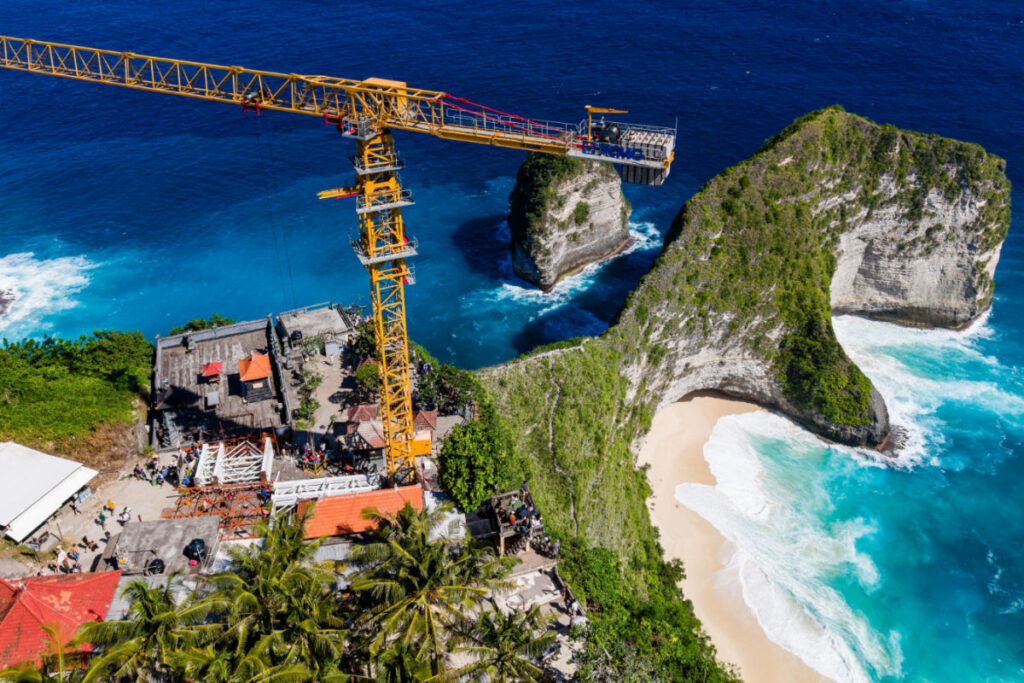
Bali’s Governor Wayan Koster has mandated the demolition of the controversial Kelingking Glass Elevator Project, following significant building violations identified last month. This decision comes after billions of rupiah were invested in the project, which has already caused irreversible changes to the iconic cliffside landscape.
The 182-meter tall Glass Elevator Project, situated in one of Bali’s most renowned tourist spots, has been ordered to be dismantled by PT Indonesia Kaishi Tourism Property Investment Development Group within six months. The announcement was made during a press conference in Denpasar on November 23rd, where Governor Koster emphasized the necessity of halting construction activities and restoring the site.
Violations and Regulatory Breaches
Governor Koster, alongside Klungkung Regent I Made Satria and the Chairman of the Special Committee for Spatial Planning, Assets, and Licensing (TRAP) of the Bali DPRD, I Made Supartha, outlined the project’s regulatory breaches. The TRAP team had already suspended construction in Nusa Penida after detecting a series of violations in early November 2025.
The investigation revealed five major violations, granting the Bali Provincial Government the authority to terminate the project. These included breaches in spatial planning, environmental regulations, licensing, marine spatial planning, and cultural tourism standards.
“The foundations of the bridge and the Glass Viewing Platform are located in coastal areas, did not receive a Recommendation from the Governor of Bali, and did not obtain a Permit for the Utilization of Conformity of Marine Spatial Utilization Activities (KKPRL) from the Ministry of Maritime Affairs and Fisheries,” explained Governor Koster.
Complex Jurisdictional Challenges
The investigation faced complexities due to overlapping jurisdictions. The ticket counter was under Klungkung Regency Government’s authority, while the flyover and the elevator were under the Bali Provincial and Central Government. The project’s scope included an 846 m2 area and a height of 182 meters, intensifying the regulatory challenges.
Governor Koster cited the first violation under Bali Provincial Regulation Number 3 of 2020, which amended the Bali RTRWP 2009-2029. Additional breaches included environmental and licensing violations under Government Regulation Number 5 of 2021, and marine spatial planning breaches under Law Number 27 of 2007.
Restoration and Future Implications
The Bali Provincial Government and PT Indonesia Kaishi Tourism Property Investment Development Group are now tasked with restoring Kelingking Beach to its original state. The beach is not only a key tourist destination in Nusa Penida but also one of the world’s most iconic viewpoints.
Since its proposal, the Glass Elevator Project has faced criticism from local communities, environmentalists, and global Bali enthusiasts. The project’s cancellation is seen as a victory for those advocating for sustainable tourism and environmental preservation.
Looking Ahead
The demolition order sets a precedent for future developments in Bali, emphasizing the importance of adhering to regulatory standards and preserving cultural and environmental heritage. It also highlights the need for comprehensive planning and stakeholder engagement in tourism projects.
As Bali continues to balance development with conservation, the outcome of the Kelingking Glass Elevator Project will serve as a critical case study for future initiatives. The region’s authorities are expected to strengthen regulatory frameworks to prevent similar issues.
The next steps involve close monitoring of the demolition process and ensuring the restoration aligns with environmental and cultural standards. The Bali government aims to use this experience to foster more responsible and sustainable tourism practices across the island.