



A site in the San Juan Basin of northwestern New Mexico is offering a rare glimpse into the last days of the dinosaurs. Rocks and fossils at the Naashoibito Member site reveal an ecosystem teeming with diverse dinosaur species just before their sudden extinction from Earth.
Paleontologists have long debated whether dinosaurs went extinct abruptly following a 6.2-mile-wide (10-kilometer-wide) asteroid impact in Mexico’s Yucatán Peninsula 66 million years ago, or if they were already in decline due to weakened ecosystems. The key to answering this question lies in finding fossils and accurately dating the surrounding rock to establish a precise timeline. However, identifying fossils in areas accurately dated to just before the extinction event remains a rare achievement.
New Discoveries in the Naashoibito Member
The Naashoibito Member site has now been dated to the same period as the well-studied Hell Creek Formation, located in Montana, Wyoming, and the Dakotas. This new research has unveiled the types of dinosaurs that inhabited different parts of North America just a few hundred thousand years before their extinction.
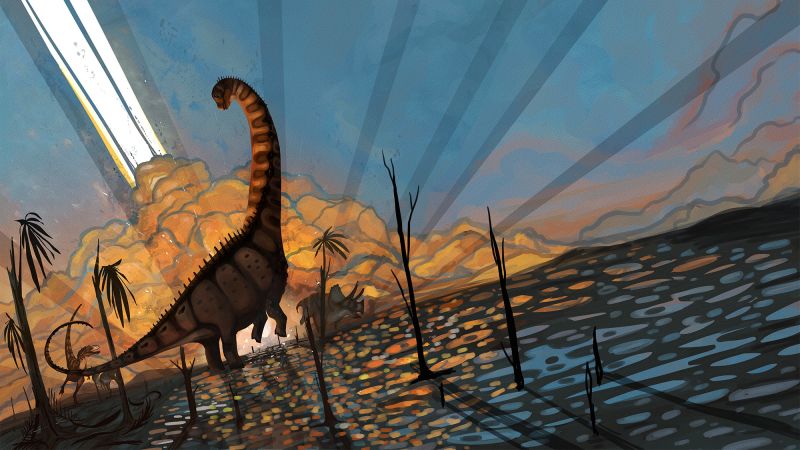
Among the dinosaurs identified at the Naashoibito Member was Alamosaurus, one of the largest long-necked dinosaurs ever discovered. According to a study published in the journal Science, this finding challenges the notion of a gradual decline in dinosaur diversity leading up to the mass extinction.
“What our new research shows is that dinosaurs are not on their way out going into the mass extinction,” said Andrew Flynn, lead study author and assistant professor in the department of geological sciences at New Mexico State University. “They’re doing great, they’re thriving, and the asteroid impact seems to knock them out.”
Challenges in Dating Fossils
Dinosaur fossils were first discovered in the San Juan Basin in the mid- to late 1800s. However, dating the rock layers containing these fossils is complex. The layers must be exposed for study, and the rocks themselves need to be dated accurately.
Flynn explained that these factors make dinosaur-bearing rocks from the last 400,000 years of the Cretaceous quite rare. Establishing the ages of rocks requires years of work and multiple lines of evidence, which can deter researchers from exploring new areas.
“Species might have failed to enter the fossil record, they might have been preserved as fossils but not yet discovered, or they might have been discovered but lack essential context,” wrote Dr. Lindsay Zanno, head of paleontology at the North Carolina Museum of Natural Sciences, in a related article.
The Naashoibito Member site poses additional challenges due to erosion, which has stripped it of the perfect rock layers found at other North American sites. Work to determine a detailed timeline of dinosaur habitation began in 2011, involving meticulous measurements of rock layers, sample collection, and fossil identification.
Reconstructing the Past
One method used to date the rocks involved comparing samples with Earth’s magnetic field, which periodically changes direction. By measuring the magnetic field’s direction when the rock layers were formed, researchers could narrow down the time frame.
“The end-Cretaceous mass extinction, fortunately for us, took place during a relatively short period of reversed polarity, which makes it much easier to say what our data correlates to,” Flynn said.
The team also employed radiometric dating on sand grains from sandstone in the Naashoibito Member, revealing that the dinosaur fossils dated from a 380,000-year window leading up to the mass extinction. Mammals appeared approximately 350,000 years after the extinction event.
Diverse Dinosaur Communities
The study paints a picture of two distinct dinosaur communities divided between the north and south regions of the continent. Both areas shared species such as Tyrannosaurus rex and Torosaurus, but differed in their duck-billed dinosaur groups. Notably, the north lacked giant, long-necked sauropods, which were abundant in the south.
“I can imagine the scene, one minute a jet plane-sized dinosaur was shaking the ground as it walked, the next minute the whole Earth was shaking with the energy unleashed by the asteroid,” said Steve Brusatte, a professor of paleontology and evolution at the University of Edinburgh.
Climate conditions likely contributed to these differences, with the Naashoibito Member resembling a warm, humid tropical forest, while the Hell Creek area featured cooler conditions of an inland sea coastal plain.
Michael Benton, professor of vertebrate paleontology at the University of Bristol, noted that while the new evidence is exciting, it represents just one location and not the complexity of dinosaur faunas across North America or the world.
“As the authors also show in the paper, in general dinosaurs of the last 6 million years of the Cretaceous were less diverse, falling from 43 species beforehand to 30 species in western North America,” Benton wrote.
Meanwhile, Darla Zelenitsky from the University of Calgary believes the findings could alter perceptions of dinosaur populations before the mass extinction, aligning with her team’s work in Alberta.
“The research team uncovered compelling new evidence (…) that dinosaurs were still going strong ‘til the very end,” Zelenitsky wrote.
While the study focuses on dinosaurs, it underscores a broader lesson about the impact of sudden climate and environmental changes on ecosystems, as noted by Brusatte.
“Sudden climate and environmental change can catch animals and ecosystems unaware, and can defeat even the strongest and most iconic of species,” he said.