


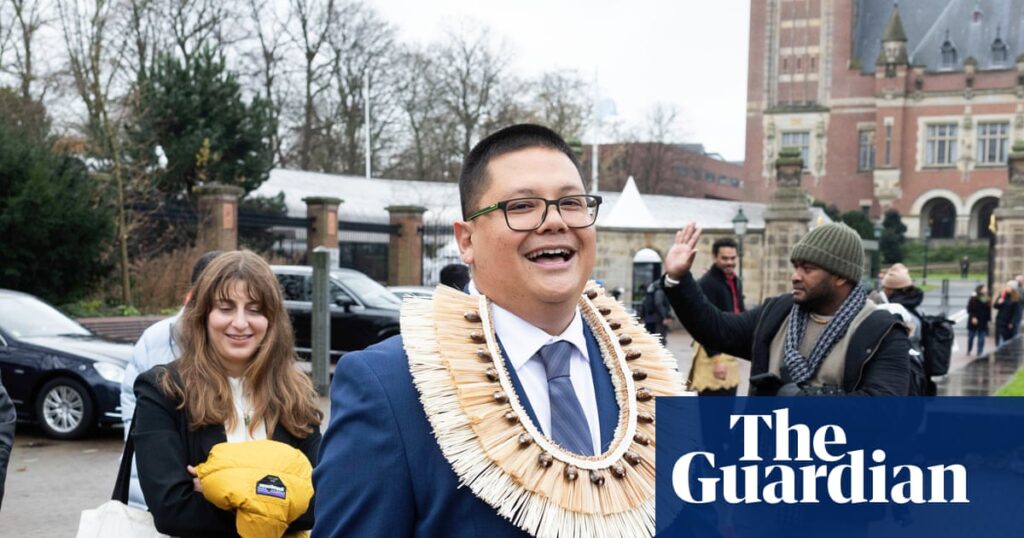
Six years ago, Julian Aguon, a human rights lawyer from Guam, received an unexpected call from Vanuatu’s foreign affairs minister. The minister sought Aguon’s expertise to develop a legal case representing dozens of law students pursuing climate justice at the world’s highest court. This initiative aimed to address legal ambiguities that Aguon believed had hindered the international community’s response to the climate crisis.
Over subsequent years, Aguon and his team collected testimonies from across the Pacific, including Vanuatu and Papua New Guinea. These accounts, often shared in defiance of cultural protocols, revealed the profound impact of climate change on local communities and their environments. The goal was to harness these stories to drive meaningful change.
Historic Ruling at The Hague
In 2025, Aguon presented the case before the International Court of Justice (ICJ) in The Hague. The court’s landmark ruling established that nations have a legal obligation to prevent climate harm, marking a pivotal moment in climate accountability. Aguon described the ruling as a mandate for countries to address the climate crisis “finally and decisively.”
This development follows the recent announcement that Aguon and the Pacific Islands Students Fighting Climate Change (PISFCC) will receive the Right Livelihood Award on December 2. This international prize, sometimes referred to as the “alternative Nobel,” recognizes their groundbreaking work. Other honorees include a Myanmar activist group, a grassroots aid organization in Sudan, and Taiwanese civic hacker Audrey Tang.
The Significance of the Right Livelihood Award
Established in 1980 after the Nobel Foundation declined to create prizes for environmental and developmental work, the Right Livelihood Award has honored figures like Edward Snowden, Wangari Maathai, and Greta Thunberg. Vishal Prasad, director of PISFCC, stated that the award celebrates the collective efforts of Pacific Islanders in preserving their homeland. “The recognition belongs to everyone in the region,” he emphasized.
Aguon believes the award will bolster a wave of rights-based climate litigation, leading to reparations claims and compensation for ecosystem restoration. His firm, Blue Ocean Law, founded in 2014, champions Indigenous rights and cultural preservation, advocating for a “new legal order rooted in respect, reciprocity, and responsibility to future generations.”
Legal Innovations and Indigenous Advocacy
Ralph Regenvanu, the Vanuatu minister who initially contacted Aguon, explained their choice of Blue Ocean Law, highlighting the firm’s ability to represent legal and cultural dimensions. Looking ahead, the firm is preparing legal challenges against deep-sea mining in the Pacific. These efforts are grounded in Indigenous guardianship, viewing the ocean as “kin rather than commodity” to safeguard marine ecosystems and cultural heritage.
Additionally, Blue Ocean Law is exploring legal avenues to combat land and water contamination, aiming to protect Indigenous rights to access and gather medicinal plants essential for cultural practices. Aguon’s work seeks to safeguard Indigenous rights in “exceedingly practical, concrete ways,” emphasizing the importance of enabling Indigenous communities to thrive within their ancestral lands.
“It behooves us to try to find every possible way to protect them and their ability to thrive in their ancestral spaces,” Aguon stated, underscoring the urgency of his mission.
Implications and Future Directions
The ICJ ruling and subsequent recognition of Aguon’s work represent a significant shift towards integrating Indigenous perspectives in global climate policy. This development raises the possibility of increased legal actions that prioritize environmental justice and Indigenous sovereignty.
As the global community grapples with the escalating climate crisis, Aguon’s efforts highlight the critical role of Indigenous knowledge and legal frameworks in crafting sustainable solutions. The ongoing work by Blue Ocean Law and similar entities may pave the way for a more inclusive and equitable approach to environmental governance.
In conclusion, the landmark ICJ ruling and the Right Livelihood Award signal a transformative moment in the fight for climate justice and Indigenous rights. As Aguon and his team continue their advocacy, the world watches closely, hopeful for a future where legal systems uphold the principles of respect, reciprocity, and responsibility.