




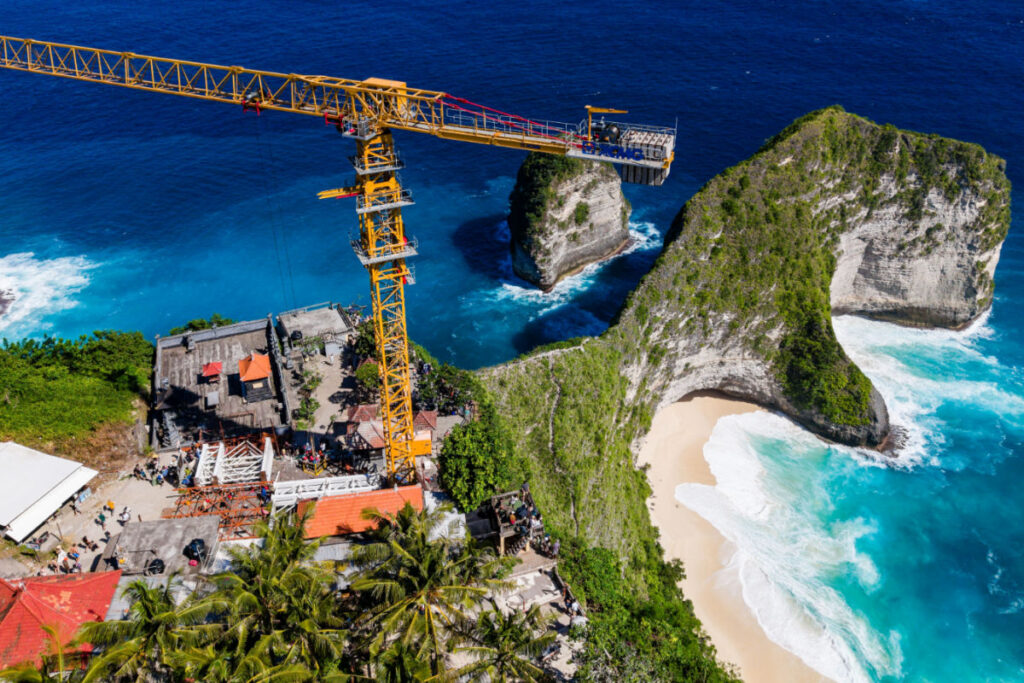
Bali’s Governor Wayan Koster has officially mandated the demolition of the contentious Kelingking Glass Elevator Project following significant building violations recorded recently. The project, which has attracted billions of rupiah in investment, has already altered the iconic cliffside of Nusa Penida, sparking widespread concern.
The governor has given PT Indonesia Kaishi Tourism Property Investment Development Group a six-month deadline to dismantle all structures associated with the project. The announcement was made during a press conference in Denpasar on Sunday, November 23, where Governor Koster stated, “I am ordering PT Indonesia Kaishi Tourism Property Investment Development Group to stop all construction activities of the Glass Viewing Platform, carry out the demolition independently within a maximum of six months, and carry out the restoration of the function of the space after the demolition within a maximum of three months.”
Background and Investigation
The Kelingking Glass Elevator Project, envisioned as a towering 182-meter structure, has been under scrutiny since its inception. The project was halted earlier this month by the Special Committee for Spatial Planning, Assets, and Licensing (TRAP) of the Bali DPRD after multiple violations were identified. Governor Koster was joined by Klungkung Regent I Made Satria and TRAP Chairman I Made Supartha during the announcement.
The investigation revealed that the project involved complex jurisdictional issues, with different components falling under various governmental authorities. For instance, the ticket counter was planned on land governed by the Klungkung Regency, while the elevator’s flyover was under the Bali Provincial and Central Government’s jurisdiction.
Violations and Regulatory Breaches
The investigation uncovered five key violations, empowering the Bali Provincial Government to terminate the project. The first was a breach of Spatial Planning regulations, specifically Bali Provincial Regulation Number 3 of 2020. Governor Koster highlighted, “The foundations of the bridge and the Glass Viewing Platform are located in coastal and coastal areas, did not receive a Recommendation from the Governor of Bali, and did not obtain a Permit for the Utilization of Conformity of Marine Spatial Utilization Activities (KKPRL) from the Ministry of Maritime Affairs and Fisheries.”
The project violated environmental, licensing, and marine spatial planning regulations, as well as standards for culture-based tourism.
Additional violations included environmental breaches per Government Regulation Number 5 of 2021, licensing infractions, and non-compliance with Marine Spatial Planning laws. The final violation related to cultural tourism standards as stipulated in Bali Provincial Regulation Number 5 of 2020.
Impact on Kelingking Beach and Local Community
Kelingking Beach, renowned for its breathtaking views, is a major tourist attraction in Nusa Penida and globally. The Glass Elevator Project has faced criticism from local communities, environmentalists, and global Bali enthusiasts since it was first proposed. The irreversible changes to the landscape have heightened calls for restoration.
The Bali Provincial Government and PT Indonesia Kaishi Tourism Property Investment Development Group are now tasked with restoring the area to its original state. This restoration is crucial not only for environmental reasons but also to preserve the cultural and aesthetic value of the site.
Future Implications and Next Steps
The demolition order represents a significant step in maintaining Bali’s cultural and environmental integrity. It also sets a precedent for future developments, emphasizing the importance of adhering to regulatory frameworks and community interests.
As Bali continues to balance development with sustainability, this case underscores the need for comprehensive planning and oversight. The restoration efforts will be closely monitored, ensuring that Kelingking Beach remains a cherished natural wonder for generations to come.
Meanwhile, stakeholders and authorities will likely engage in discussions to prevent similar issues in future projects, fostering a more sustainable approach to tourism development in Bali.