




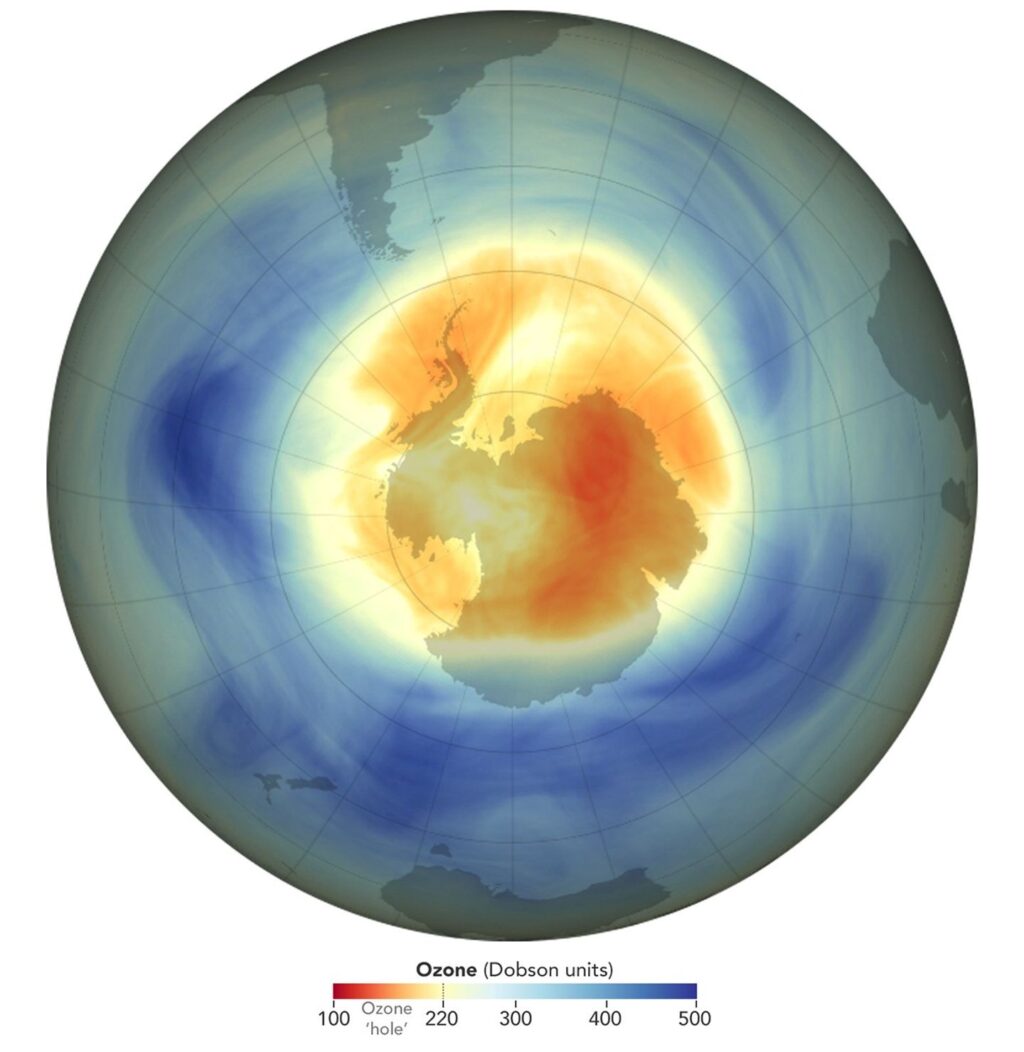
The ozone hole over Antarctica in 2025 has been reported as the fifth smallest since 1992, according to NASA and the National Oceanic and Atmospheric Administration (NOAA). This marks a significant milestone in the ongoing recovery of the ozone layer, which is expected to fully recover later this century. The reduction in size is attributed to international efforts to phase out ozone-depleting chemicals.
During the peak depletion season from September 7 to October 13, the average size of the ozone hole was approximately 7.23 million square miles (18.71 million square kilometers), equivalent to twice the area of the contiguous United States. Notably, the 2025 ozone hole began breaking up nearly three weeks earlier than the average over the past decade.
Historical Context and Recovery Efforts
The ozone hole reached its maximum one-day extent on September 9, measuring 8.83 million square miles (22.86 million square kilometers). This size is about 30% smaller than the largest hole ever recorded in 2006, which averaged 10.27 million square miles (26.60 million square kilometers).
Paul Newman, a senior scientist with the University of Maryland, Baltimore County, and leader of the ozone research team at NASA’s Goddard Space Flight Center, observed,
“As predicted, we’re seeing ozone holes trending smaller in area than they were in the early 2000s. They’re forming later in the season and breaking up earlier. But we still have a long way to go before it recovers to 1980s levels.”
The gradual recovery of the ozone layer is largely credited to the Montreal Protocol, a landmark international agreement established in 1987 to phase out ozone-depleting substances. This agreement, along with subsequent amendments, has been instrumental in reducing the presence of harmful chemicals in the atmosphere.
The Science Behind Ozone Depletion
The ozone layer, located in the stratosphere between 7 and 31 miles above Earth’s surface, acts as a protective shield against the Sun’s harmful ultraviolet (UV) rays. A thinner ozone layer allows more UV radiation to reach the Earth’s surface, leading to increased risks of skin cancer, cataracts, and crop damage.
Ozone depletion occurs when human-made compounds containing chlorine and bromine reach the stratosphere. These compounds, once freed by intense UV radiation, participate in reactions that destroy ozone molecules. Chlorofluorocarbons (CFCs) and other ozone-depleting substances were once commonly used in products such as aerosol sprays, foams, air conditioners, and refrigerators. Despite being banned, these chemicals can linger in the atmosphere for decades.
Stephen Montzka, a senior scientist with NOAA’s Global Monitoring Laboratory, noted,
“Since peaking around the year 2000, levels of ozone-depleting substances in the Antarctic stratosphere have declined by about a third, relative to pre-ozone-hole levels.”
Current Monitoring and Future Projections
NASA and NOAA scientists continue to monitor the ozone layer using a combination of satellite data and ground-based instruments. The 2025 ozone hole ranks as the 14th smallest over 46 years of satellite observations, dating back to 1979.
Factors such as temperature, weather patterns, and the strength of the polar vortex also influence ozone levels. This year, a weaker-than-normal polar vortex in August contributed to higher-than-average temperatures, likely aiding in the smaller size of the ozone hole, according to Laura Ciasto, a meteorologist with NOAA’s Climate Prediction Center.
NOAA scientists employ a variety of tools, including weather balloons and surface-based instruments, to measure stratospheric ozone levels. This year, balloon data recorded the lowest ozone concentration at 147 Dobson Units on October 6. For context, the lowest value ever recorded was 92 Dobson Units in October 2006.
The Dobson Unit is a measure of the total number of ozone molecules in a column of the atmosphere. A reading of 100 Dobson Units corresponds to a layer of pure ozone 1 millimeter thick under standard conditions.
Looking Ahead
Despite the progress, challenges remain. Legacy uses of banned chemicals, such as those found in old building insulation and landfills, continue to emit ozone-depleting substances. However, as these emissions decrease over time, projections suggest that the Antarctic ozone hole will recover by the late 2060s.
For ongoing updates on the status of the ozone layer, NASA provides resources such as their ozone watch. The continued collaboration between international agencies and adherence to environmental protocols remain crucial in safeguarding the planet’s ozone layer.
By Sally Younger
NASA’s Earth Science News Team